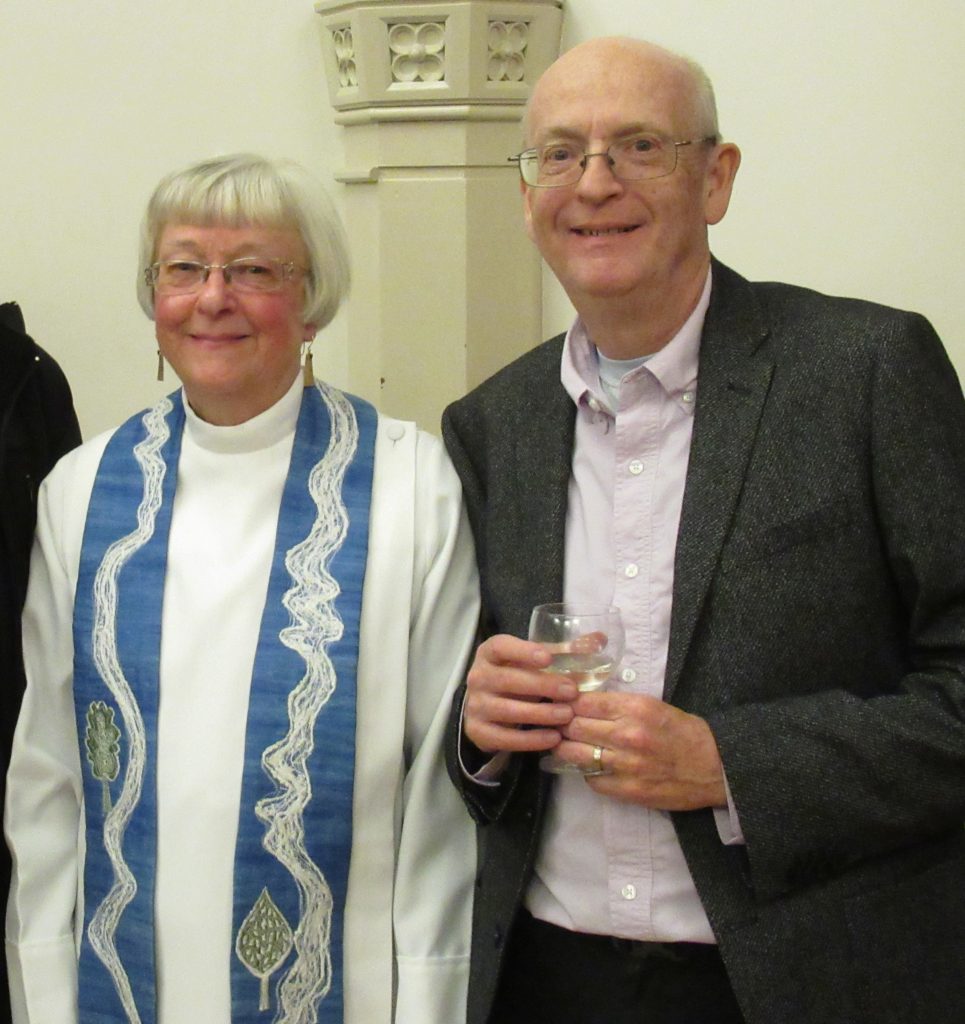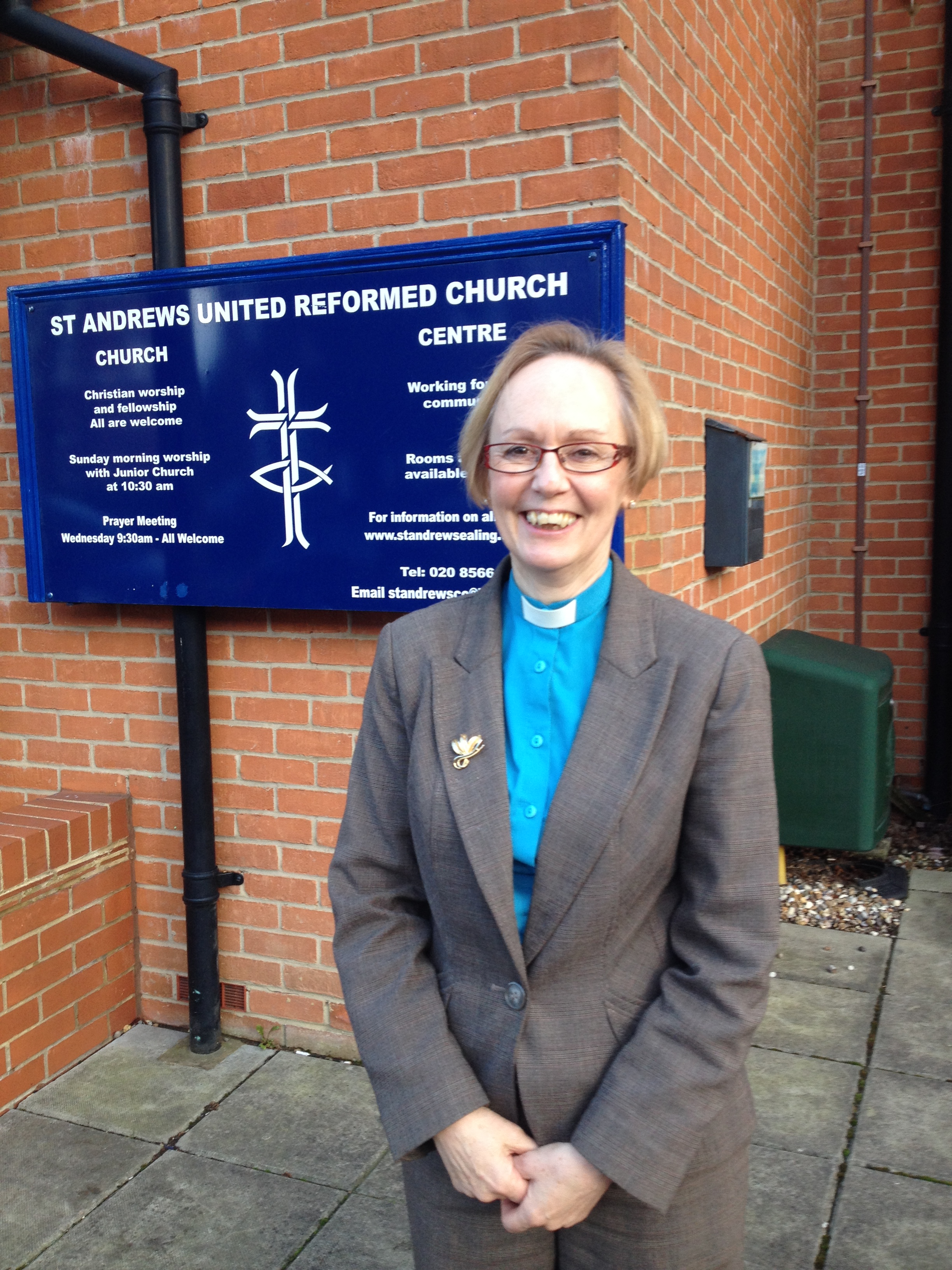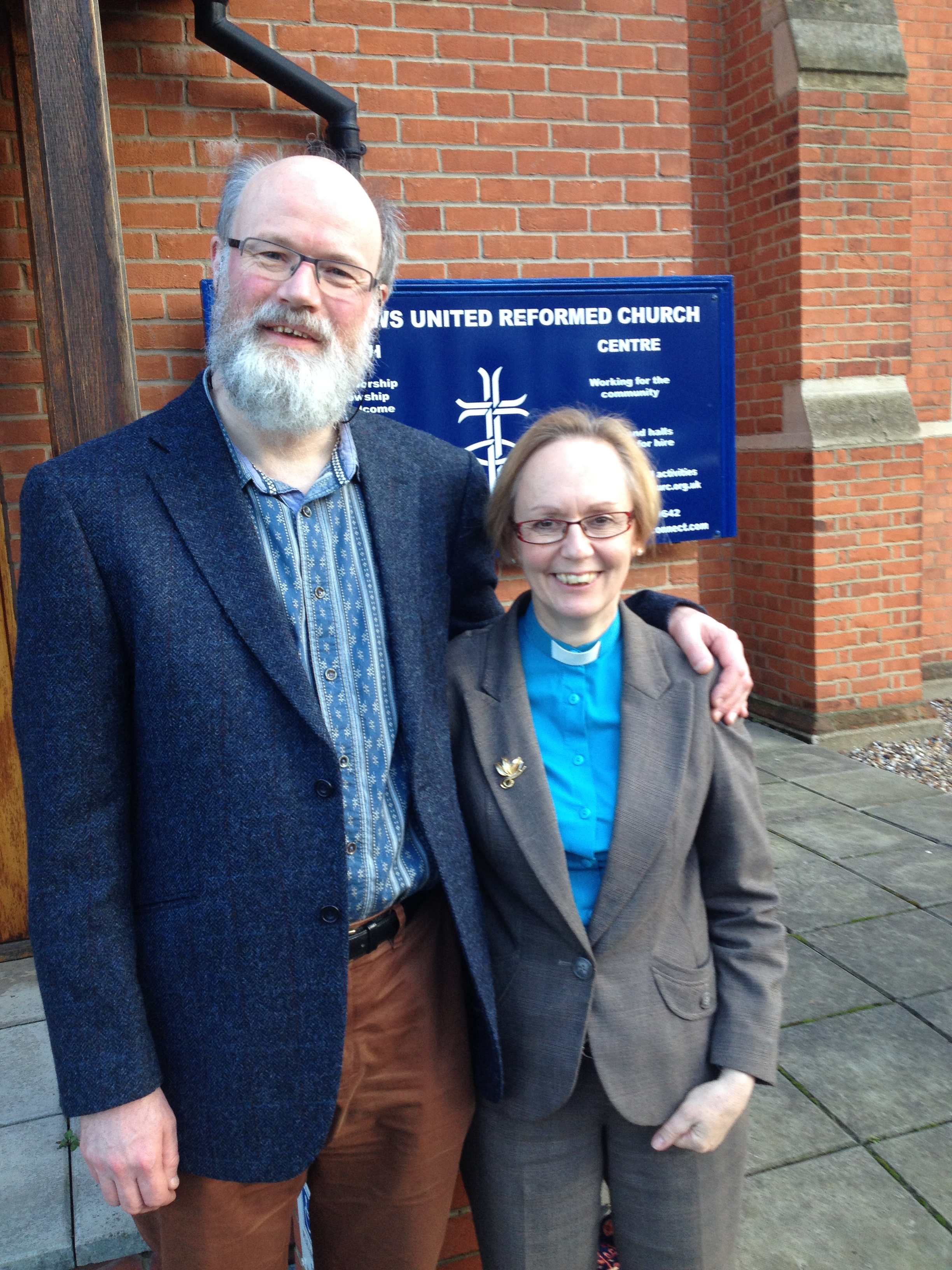

50th anniversary of ordination of Revd Dr Elizabeth Welch: how we got here!
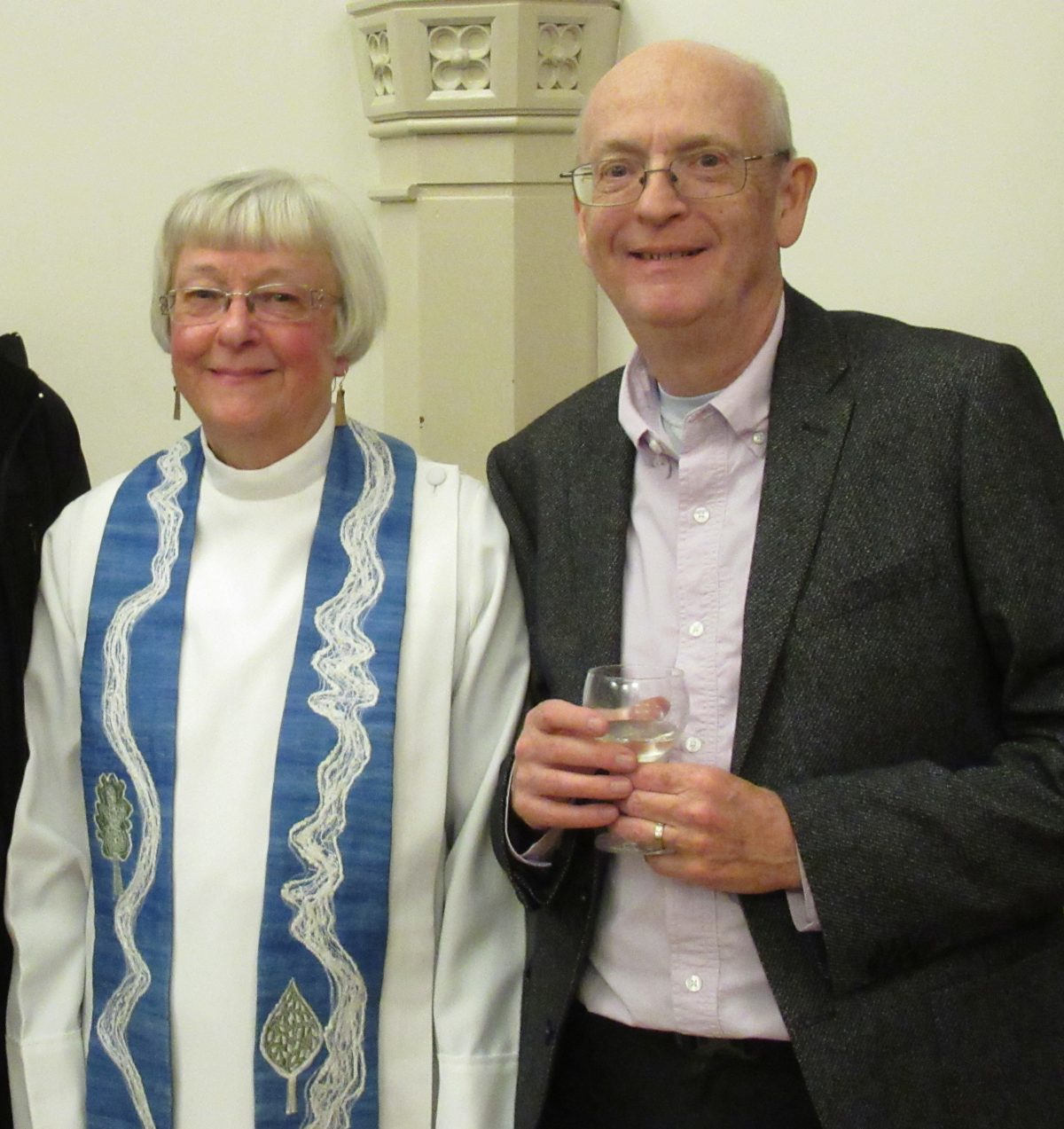
On 25th April 2026, we will be holding a special service at St Andrew’s URC, to mark the 50th anniversary of Elizabeth’s ordination. This article gives some background information, which I hope will be of interest.
I first met Elizabeth in September 1971: she was in the year ahead of me at New College, London, where we both studied theology. Elizabeth felt called to the Congregational ministry, like her father and grandfather before her. My own interest was to understand more fully the Christian faith, convinced that there were greater depths to explore than had always been evident in my Methodist upbringing! Elizabeth also had an enquiring approach and that, combined with her passion for racial and social justice, became the basis of a student friendship that, by the end of 1973, had grown into something deeper.
Just as things were starting to get serious between us, in September 1974 Elizabeth went to the USA, where she spent a year on further studies to prepare her for ministry. During her absence I shared a flat in Notting Hill with two friends, and embarked on the early stages of my career as an academic librarian: working as a Graduate Trainee in the library of Bedford College, London, based in Regent’s Park.
In the autumn of 1975, I flew for the very first time, and joined Elizabeth in New York so that we could travel together in the USA, giving me a taste of what she’d experienced during her year in America. Back in the UK, by early 1976 the URC had identified a possible church for Elizabeth, and in due course she was called to serve at St Barnabas United Church and Christian Centre, a new church (still under construction) in Langney, a major new housing development on the eastern flank of Eastbourne.
Before Easter Elizabeth moved into what became our first Manse – a new council flat above a doctor’s surgery, on a large council estate. St Barnabas was a Local Ecumenical Partnership between Baptists, Methodists and the URC. The building wasn’t yet ready for use, so Elizabeth’s ordination and induction took place at Upperton Road URC in the older part of Eastbourne, on 24th April 1976. Until our own church building was ready the ‘free church’ congregation met for worship each week at St Richard’s Church of England, just over a mile away.
I was still living in Notting Hill and working at Bedford College, visiting Langney each weekend. It was a busy time, but we managed to fit in getting married on 6th November, the third wedding in the newly opened church building. This resulted in me commuting from Eastbourne to London for work, and then to study (I spent most of 1977 on a Post-graduate Diploma in Librarianship at the Polytechnic of North London.
Within a few months of St Barnabas opening it was already a thriving church, attracting retired people from the surrounding private estates as well as young families primarily from the council estate. The church soon had groups for pre-school kids, seniors, youth, and Boy’s and Girl’s Brigades; services were well-attended and the Junior Church was packed. It soon became clear that St Barnabas was too small a building for all the activities based there, so we prepared for an extension project to more than double the building in size.
My own career took off, first, in 1978, with a job in the library of East Sussex College of Higher Education on the other side of Eastbourne. Then, in 1980, promotion to a more responsible post at Brighton Polytechnic in the Department of Learning Resources.
At St Barnabas a lot of effort went into agreeing the design of the extension and to fund-raising. When completed, the extended building was a great success, making it far more comfortable to accommodate the range of activities at the church. Just as it looked as though we could enjoy the benefits of all the hard work we faced another change: Elizabeth was called to join the clergy team at the Church of Christ the Cornerstone in Milton Keynes city centre, where we moved in May 1983.
Milton Keynes was an ambitious, city-sized development, and the churches had responded equally ambitiously to the challenges, with an ecumenical commitment throughout. Christ the Cornerstone was a five-church Local Ecumenical Partnership (Anglican, Baptist, Methodist, Roman Catholic and United Reformed Church). Elizabeth joined a team comprising two Anglican clergy, with an ecumenical congregation meeting in leased rooms in the central library building. The team changed over the years, including being joined by a Roman Catholic nun, and a Methodist minister.
The BIG challenge was to plan and fund-raise for a new city centre, ecumenical, church that would make a strong visible presence in the midst of all the retail and office buildings. This took several years, with one false start, and a process involving the clergy team and the congregation in regular discussions, working through different aspects.
Elizabeth and I lived in a new town-house right in the centre of the city – our second non-conventional Manse. Being based in Milton Keynes meant that I had a slight adjustment to my career: from polytechnic or university libraries to government department ones, but building on work I’d started at Brighton on increasing computerisation of library processes. In July 1983, I started work at the library of the Ministry of Agriculture, Fisheries & Food [MAFF] in Whitehall, beginning a period of longer-distance commuting. Subsequently, in September 1986, I moved to a more senior role at the library of HM Treasury & Cabinet Office. And again, in January 1990, another promotion: this time away from libraries into an IT post at the Central Computer & Telecommunications Agency [CCTA].
While I was enjoying my increasingly computer based work, things were moving forward at Christ the Cornerstone: a building design agreed, funding largely in place, and then building work started – a fascinating process given the size and appearance (a large dome). The congregation of the city centre Church of Christ the Cornerstone began worshipping in the new building on 12th January 1992, before the official opening in March. With HM Queen Elizabeth II plus various church dignitaries in attendance, the opening service was amazing. Of particular note, it was the first time since the reformation that a Roman Catholic Cardinal (Basil Hume) had preached to a congregation including a reigning British monarch.
Later in the year, I had another significant change of job: I joined the IT support team in the House of Commons Library in October 1992. It was interesting to bring together the main strands of my career. I remained in the House of Commons / Parliamentary Service until I retired, but left the Library after eight years to work in other departments.
We enjoyed church life in the new building, but then Elizabeth was called to serve as Moderator of the West Midlands Synod of the URC.
Elizabeth started working as West Midlands Moderator in April 1996, initially commuting from Milton Keynes. By September we were able to move to the Moderator’s Manse in Solihull – our first experience of a traditional Manse, and a great house in which to gather our family together (a lovely combination of aging parents and growing nieces: Christmas Days to remember!). In February 1997 we got a flat in Westminster, close to my work, as it was too far to commute from Solihull each day and we knew that it would also be useful for Elizabeth for the regular Moderators’ meetings in London. The two-centre lifestyle had begun!
Moderators (at least then) deal with the extremes of church life: the practicalities of Ministerial placements and some depressing disciplinary issues on one hand; and the joy of ‘belonging’ to 150 or so different congregations across a diverse region. We particularly enjoyed the glorious countryside of Shropshire and Herefordshire, as well as the wonderful Symphony Hall in Birmingham.
It was during our time in the West Midlands that Elizabeth was called to serve as Moderator of the URC’s General Assembly, from 2001 to 2002. It was a real privilege to be given the opportunity to visit churches throughout the country and to sample the life of our various congregations, as well as to develop a relationship with the Church of North India (which continued as a West Midlands link).
Synod Moderators serve for a fixed term, so we knew we had to plan ahead as Elizabeth’s twelve years approached their end. In Westminster, we upgraded to a slightly bigger flat, to create a little flexibility for the future. After testing a couple of other options, Elizabeth felt that the way forward was to pursue her original inclination: part-time local ministry combined with part-time academic study.
In September 2008 Elizabeth began as half-time minister at Clapton Park URC in Hackney, and starting research half-time towards a PhD on ‘the Holy Spirit and Worship’ at Kings College, London. Clapton Park was a wonderful, creative church, with lively worship and a strong community focus – full circle back to the key themes of Langney! It was also as ethnically diverse as many of the churches in the West Midlands, and very accepting of same-sex relationships. Our main musician encouraged me to take up the mandolin, and soon had me playing in the church band.
Elizabeth’s PhD thesis developed slowly, affected first by the pressures of a busy church and then by her mother’s decline in health and subsequent death in 2017. But Elizabeth’s thesis was accepted and in September 2018 she was awarded her PhD. The thesis was subsequently accepted for publication: The Holy Spirit and Worship: transformation and truth in the theologies of John Owen and John Zizioulas. Eugene, Oregon: Pickwick Publications, 2020.
While we were in Hackney I was able to take early retirement in March 2011, and dedicate my time to playing the mandolin and doing all the laundry! The URC had by then increased the retirement age for ministers to 68, which was not a problem for someone with Elizabeth’s strong sense of vocation. But eventually ‘retirement planning’ became part of our lives.
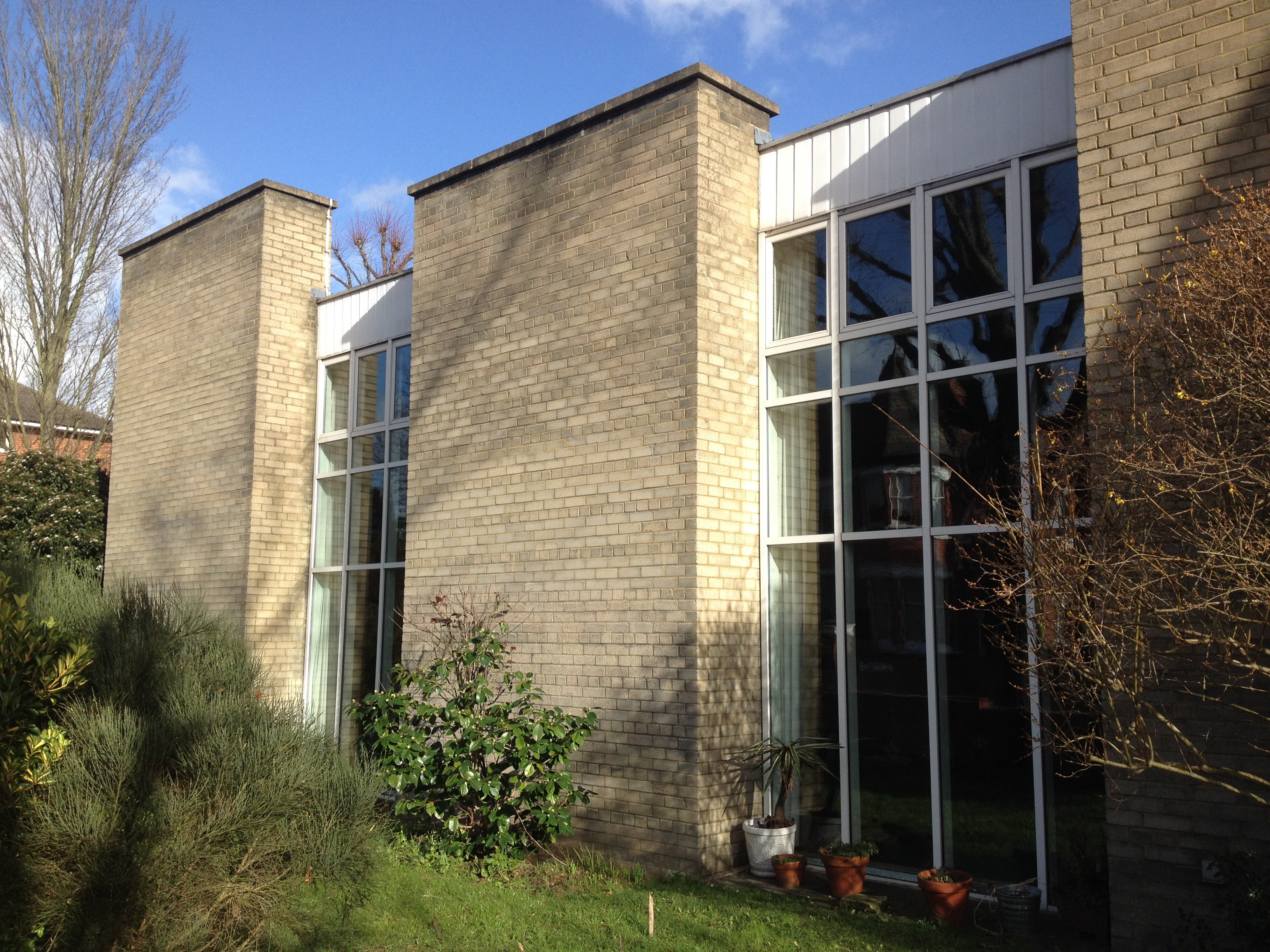
Our main preparation for Elizabeth’s retirement in February 2019 was to try to find a part of London with a church where we would feel at home. This took many visits to different churches. But in St Andrew’s URC in Ealing we found what we sought: a welcoming church, with a lovely minister, and a friendly congregation. That was the easy part: moving to Ealing required us to sell our flat in Westminster (made difficult by the collapse of the local housing market due to Brexit), and to find the right house in an accessible part of Ealing. Covid-19 made this even more tricky, but by the end of 2021 we moved into our house in Brookfield Avenue.
In ‘retirement’ Elizabeth has continued regularly leading worship (at 13 churches, in 4 synods, but mainly in Thames North and currently each month at St Andrew’s) and chairing some national committees.
We are delighted to be able to share something of our story with our friends at St Andrew’s, and to be able to celebrate Elizabeth’s 50th anniversary of ordination in our new church home.
Peter Skerratt