
Sermon given by Revd Maggie Hindley 13 September 2026
Where the river flows everything will live.
(Keynote verse for Season of Creation: Ezekiel 47:9)
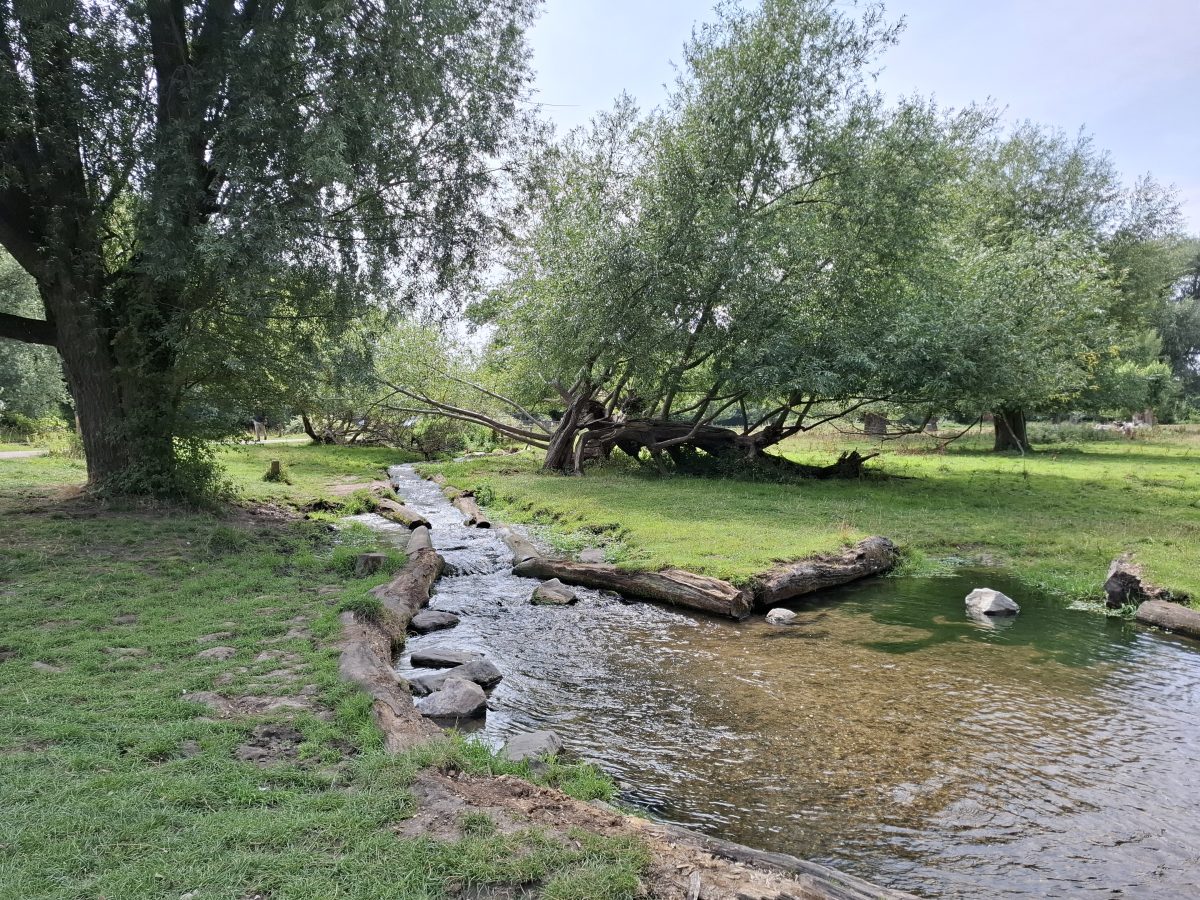
And there are loads of lovely rivers in the Bible! What’s your favourite?
Here are some: There are four rivers flowing out of the Garden of Eden.
There’s the River of Life, with its trees, at the other end of the Bible.
There’s the Jordan – crossing it, the healing of Naaman, Jesus’ baptism.
There are rivers in the psalms – Psalm 1, with its tree standing by the side of a river.
All of these references to rivers are positive. All of them are healing or nurturing or taking you somewhere.
Water, it is said, is the building block of life. Without it, zilch life as we know it. It’s 70% of the human body at birth, not much less as we grow older, and much more for plants. No wonder we love our rivers and our seas – and, this late dry summer, our rain too.
But there are problems! As you’ll have seen this year, climate change has meant that many powerful watercourses have been reduced to a trickle. And – probably to come in the next few months here – climate change brings extreme weather of other kinds and that may well mean the misery of excessive rain, and flooding – it happens over and over again in some places. I was ashamed to have to explain to my four-year-old grandson that if he fell from his beloved cable car into the Thames below, he would be very ill indeed because of the polluted water. Pollution is increasing horribly in many of our rivers in rural places, too, because of the toxic slurry rolled down into it from dairy, pork and chicken farms.
Worldwide, there’s worse. Drought and flood and water degradation can be catastrophic. Rivers in South America and Southern Africa and Australia are the most vulnerable to ecosystem change, leading to loss of life and habitat and livelihood. It affects the Amazon, and the Limpopo, and the Darling. And, of course, while the effects of Climate Changes are felt most acutely in South America and Southern Africa and Asia, it’s we in the north and west who have contributed most to the problem, filling the air with greater and greater amounts of warming greenhouse gases from the time of the Industrial Revolution till now, with the results the poorest people of the world are most affected by.
Pope Leo says, in a prayer:
Forgive us for turning water into a commodity,
forgetting that it is a universal gift,
a right without borders,
meant for all your children.
Amen to that!
Where the river flows, everything will live.
Where it doesn’t, death and destruction follow.
Water is the building block of life. We need to cherish it, and we need to cherish our rivers at home and across the world.
Have you noticed that I haven’t yet mentioned today’s lectionary readings? Genesis 50: 15-21; Matthew 18: 21-35 There‘s not a river, not a stream, not a puddle, to be found in them. They are about forgiveness. And yet there is a connection. If water is the building block of life, then forgiveness is the building block of our faith. The poet and visionary William Blake, who’s given me so much summer reading this year, thought so, felt so, personally and passionately. The religion of Jesus, for him, was first and foremost about forgiveness and friendship; so was his vision of the new Jerusalem.
I think Blake is right. I’m encouraged that right at the beginning of the Bible, in Genesis, we have Joseph’s story of harm done, reconciliation and forgiveness. It’s a very real harm – he was betrayed by his brothers into slavery. A very real forgiveness; he sets things up to bring home to them the reality of what they did but when they ask for forgiveness the floodgates open and Joseph weeps and weeps. Rivers, not of flowing water, but of tears of relief and happiness to be reunited with his brothers.
And that’s our experience as Christians, isn’t it? We come to God in the first place knowing we have deluded ourselves into putting ourselves in the centre of the universe, where God himself belongs, and that this has done harm, and asking for forgiveness. All our encounters with God start from this point – the act of baptism, every service of worship we share, our personal prayers, daily or whenever we make time to be with God. We come back for it over and over and over again. Forgiveness is never denied us. We can block it if we are not sincere, but it’s always there for us, flowing like a river, flowing like Joseph’s tears, clean and joyful.
Where forgiveness flows, everything will live,
And, just as with our rivers, it’s easy for things to go wrong. Sometimes pride or excessive shame prevents us from realising what a gift it is to receive forgiveness. I wonder what it was with the man in Jesus’ parable that we just heard? He begs and begs for forgiveness and he is saved, released, forgiven. Yet he was unable to pass the gift on. Maybe he wasn’t sincere in the first place, making his pleas purely out of self interest; and self interest dominates what he does next, which is to refuse forgiveness to another debtor, one who owes to him. How mean! He has blocked the flow of forgiveness and the result is that he is excluded from generosity, and his own release is rescinded.
Do we do that? Well, yes, we do, whenever we let resentment or contempt diminish the other in a situation where hurt has been done to or by us. We forget the beautiful, flowing stream of forgiveness that is always ours to bathe in, to restore and nourish us. And we pollute it with our egoism.
In the same way our society, I believe, pollutes the trust we need to hold our community together. We are encouraged to use litigation (Had an accident? Sue!!!!) and the terrible language of condemnation. We are encouraged to point the finger in a way deplored by the prophets. We ourselves may be condemned if we fail to use such language about selected actions and people. We need instead to cherish the building block of a good society; trust, respect and forgiveness as a goal even while we hold up a hand to say a firm ‘no’ to destructive behaviour. We need to look for ways to resolve past conflict by things like the South African Truth and Reconciliation Commission, which allowed people to speak the truth about past wrongs but denied them revenge. Can we learn to exemplify telling the truth without exercising condemnation? That way we keep the rivers of grace flowing for the good of all, a universal gift, meant for all God’s children.
Shine, Jesus, shine, we sometimes sing. Flow, river, flow, flood the nations with grace and mercy.
Enjoy the rivers you love. Cherish rivers throughout the world and do what it takes to keep them flowing. Enjoy the unending kindness of God to you. And let it flow through you, through us, into our life in the world, until it comes to reflect the generosity and mercy of the God who made it.
Where the river flows, where forgiveness flows, everything will live.
May it be so for us.