
Sermon given by Revd Maggie Hindley 22 March 2026
Readings: Ezekiel 37.1-14; John 11.1-45
So, only two weeks now till Easter. What the lectionary offers us today is a sort of rehearsal for what happens in Holy Week. It’s a preparation for the process Jesus goes through then, and that we will share, if we are attentive. We can see it’s a process that’s typical of our God, the God of new life. Studying it today may make us readier to accept the miracle of what will happen at Easter. In the Old Testament, and in Jesus’ own life, God takes what is really really dead and breathes new and abundant life into it, into them.
It’s a long story in John. We’ll hear it in three parts and I’ll say something about what’s going in between the readings.
Let’s hear the first part then. John 11: 1-16.
Lazarus is sick. In verse 15 Jesus acknowledges that he’s dead. We’re not in doubt about that; the message about his illness, and Jesus’ deliberate delay, make it all too likely. It runs the course of a normal illness; it’s certainly not the result of some conjuring trick that makes it look like he’s dead when he’s not really. Jesus’ delay has ensured Lazarus’ death, and once he sets out he puts his own life in danger, too. Thomas is in despair. Lazarus is dead. Jesus will likely be put to death. The disciples, too, will walk into mortal danger if Jesus goes off now on this fool’s errand. The time for healing is over.
We’re not in any doubt that Ezekiel’s bones are really really dead, either. The bones are many, scattered and, as the story tells us , ‘very dry’ – the debris of some battle long ago.
We who believe in the resurrection need not deny the reality of death, nor its ugliness, nor its finality. We need not cling on to hope when hope itself is lost. We might learn something from the Buddhists here. Buddhists are not encouraged to cultivate hope; not, at least in the sense of craving the restoration of things as they once were or as we might wish they would become. Such hope is easily disappointed, leaving us crushed. True hope, say the Buddhists, has nothing to do with what we desire.
As we follow in the path of the cross, then, can we let death be death? Can we allow hope to die, too? Can we be the bones, shiny and white and still; can we be Lazarus, letting go after a painful illness; can we identify with Jesus himself on Good Friday, helpless and in agony pinned to the cross; mocked, betrayed, the dream and the mission all gone, all lost? Not trying to make the best of it; accepting that the worst has come. Letting the awfulness of the world we know and hear about be as awful as it really is.
Lost. Disappointed. Dead. That’s for real. But it’s not the end of the story. Let’s hear what happens next.
John 11: 17 – 37
There’s a lot going on here. The story is pulled in opposing directions. Grief bubbles up. And at the same time there’s a sense of possibility, a sense that somehow God is doing something new.
In Ezekiel, the bones are identified as the people of God, and they themselves mourn that they have dried up, that they have lost hope, that they are cut off completely. The context is that they have been taken into exile in Babylon, and have remained in exile for two generations already. Cause for grief indeed.
In John, there’s the very strong if only humans tend to turn to when disaster strikes. If only you had been here…..says Martha. If you had been here….says Mary. Could not he who opened the eyes of the blind man have kept this man from dying? ask the neighbours, more overt in their sense of blame. And there are tears: Mary’s, the neighbours, and finally Jesus’ own. He is greatly disturbed in spirit and deeply moved. All real. All heartfelt.
And alongside the anger and sadness that go with a final loss of hope, there’s God. A commanding God, who tells the prophet to prophesy to the bones so that they come together, foot to ankle to knee to hip right up to the skull like speeded-up flatpack assembly. Then Ezekiel is to prophesy to the breath, and make it life for the new bodies.
It’s a God who, in Jesus, interrogates Mary about the resurrection. Do you believe? Watch this space……I am the resurrection and the life.
It’s like the mood of Holy Saturday, my favourite day of the Christian year. Jesus is really and truly dead and in the tomb, and yet there is this growing sense of his presence mysteriously filling the universe, as the little hymn has it:
Christ, filling all things, ever unconfined.
So, for us, when hope is dead, when we suffer huge loss or disappointment, when we see the powerful of the earth imposing their will on the less powerful ruthlessly, unstoppably, what are we to do? We are, in our grief, to watch and listen and wait and be ready to do what God asks of us; to prophesy, perhaps; to trust and obey and, finally, to roll away the stone as the stone of Jesus’ tomb will be rolled away on Easter morning. That’s the distinctively Christian response to the loss of hope; we trust, not knowing; we wait, not knowing what it is we wait for. These next two weeks are a time to cultivate that trust. Sorrow in one hand, joy in the other; holding both together and waiting.
TS Eliot understands this:
I said to my soul, be still, and wait without hope
For hope would be hope for the wrong thing
Waiting until God does the unexpected. Here’s how:
John 11: 38-45
There is new life, but it doesn’t come from us.
The bones become skeletons and the skeletons become people and the people become an army, or perhaps better to think of them as a nation, returning from exile to their homeland. O my people. God’s people. Loved and made new.
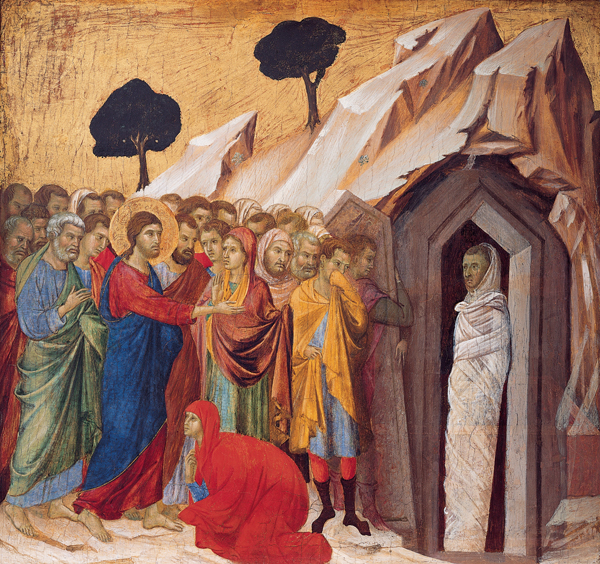
God loves them as Jesus loves his good friend Lazarus and, greatly disturbed as he is, has the stone removed and commands Lazarus, come out! And he does. And lives again.
God loves them as he loves his disciples. Scattered as they are on Good Friday, but for the women, this tomb too is empty, this body – Jesus’ – also walks and talks and eats with them. This new people comes together to form a new community of believers, something they didn’t expect or plan for. And the company of people who know Jesus as The Resurrection and the life grows and grows.
How have you seen life after death in your own experience? Maybe long after you have grieved some great disappointment and a new door has opened and you have walked through. Where have you seen it in the history of our times? South Africa, maybe, and Northern Ireland. Where do you hope (without hope) to experience resurrection in the coming time, in your life, in the life of the church, in the life of the world? Mourn what is lost, thoroughly. Feel the pain. And listen, listen, listen for how God is stirring at the centre of the devastation and destruction.
The darkness shall be the light,,and the stillness the dancing.
Easter resurrection is not a one-off. It’s the habitual pattern of behaviour for the God of Jesus. Know it and live it, today and every day.
PICTURE SHOWS: ‘The Raising of Lazarus’, Duccio, Copyright Kimbell Art Museum